Getting to the Point

This story was published in Nikkei Asia here.
The woman in the bright orange and red sari looked remarkably composed for someone who had a metal skewer going into one cheek and coming out of the other. Her poise and focus were mirrored by dozens of other pilgrims who likewise sported excruciating-looking piercings. Some even had metal hooks embedded in the flesh of their backs that acted as anchors, either for huge wooden frames towering over their heads or for ropes that were held like reins by their companions. But despite such self-mutilation, none showed any visible signs of distress, instead exuding an aura of peace and calm that hinted at being on another mental plane altogether. Together with the drumming and the tides of rhythmic chanting, it all made for a distinctly trance-like atmosphere.

They were celebrating the Tamil Hindu festival of Thaipusam, which had kicked off at the stroke of midnight in front of Kuala Lumpur’s Sri Maha Mariamman Temple. I had joined thousands of Malaysian Tamils gathered there, ready to accompany a lavishly decorated chariot on its overnight journey to the Batu Caves outside of the city. It carried a statue of Lord Murugan, a Hindu god renowned for defeating the demon Surapadman and his minions when they tried to engulf the world in evil. Thaipusam celebrates his victory over them and is an opportunity to give thanks for everything that’s positive in life, as well as to pray for more of the same in the future.
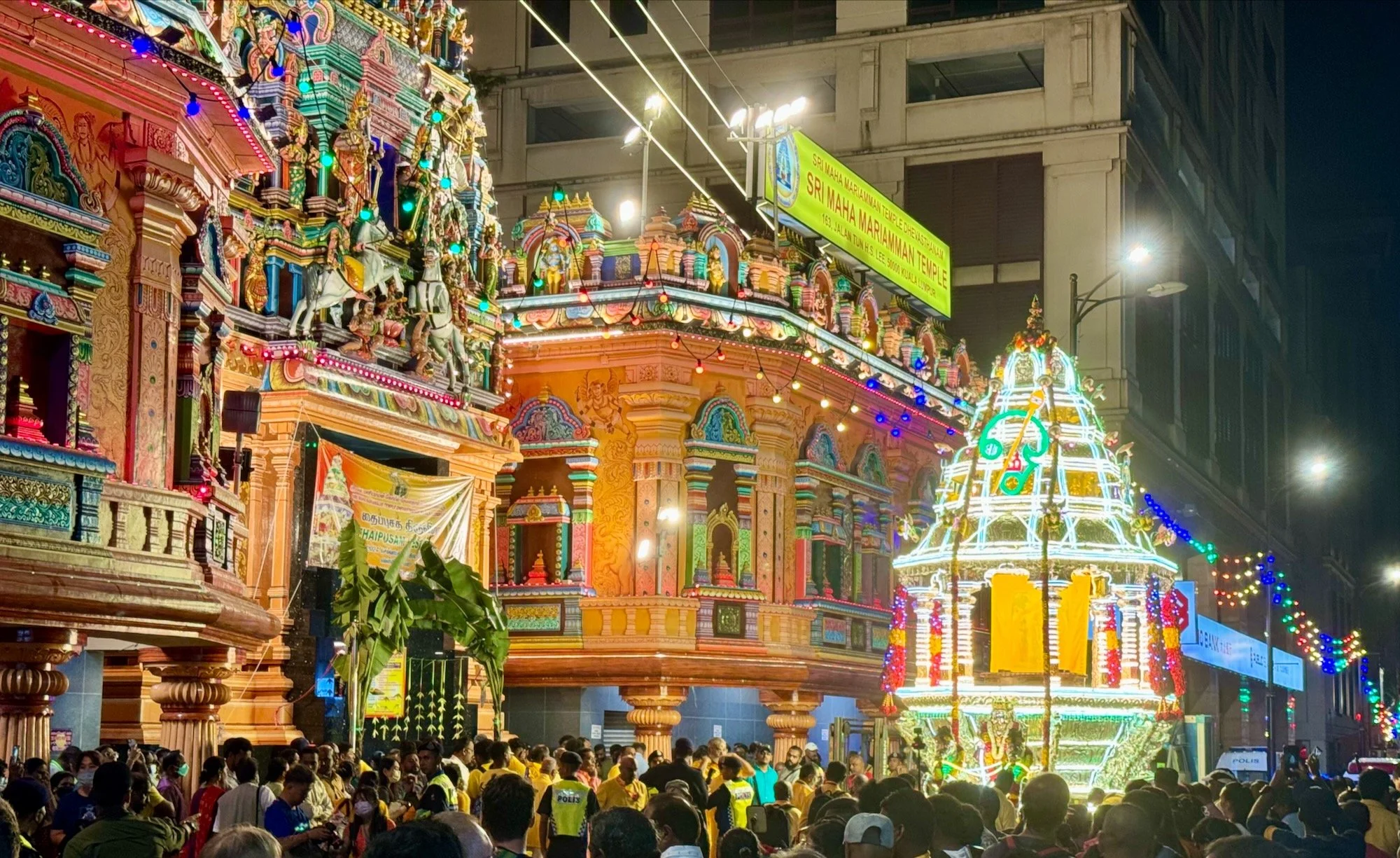
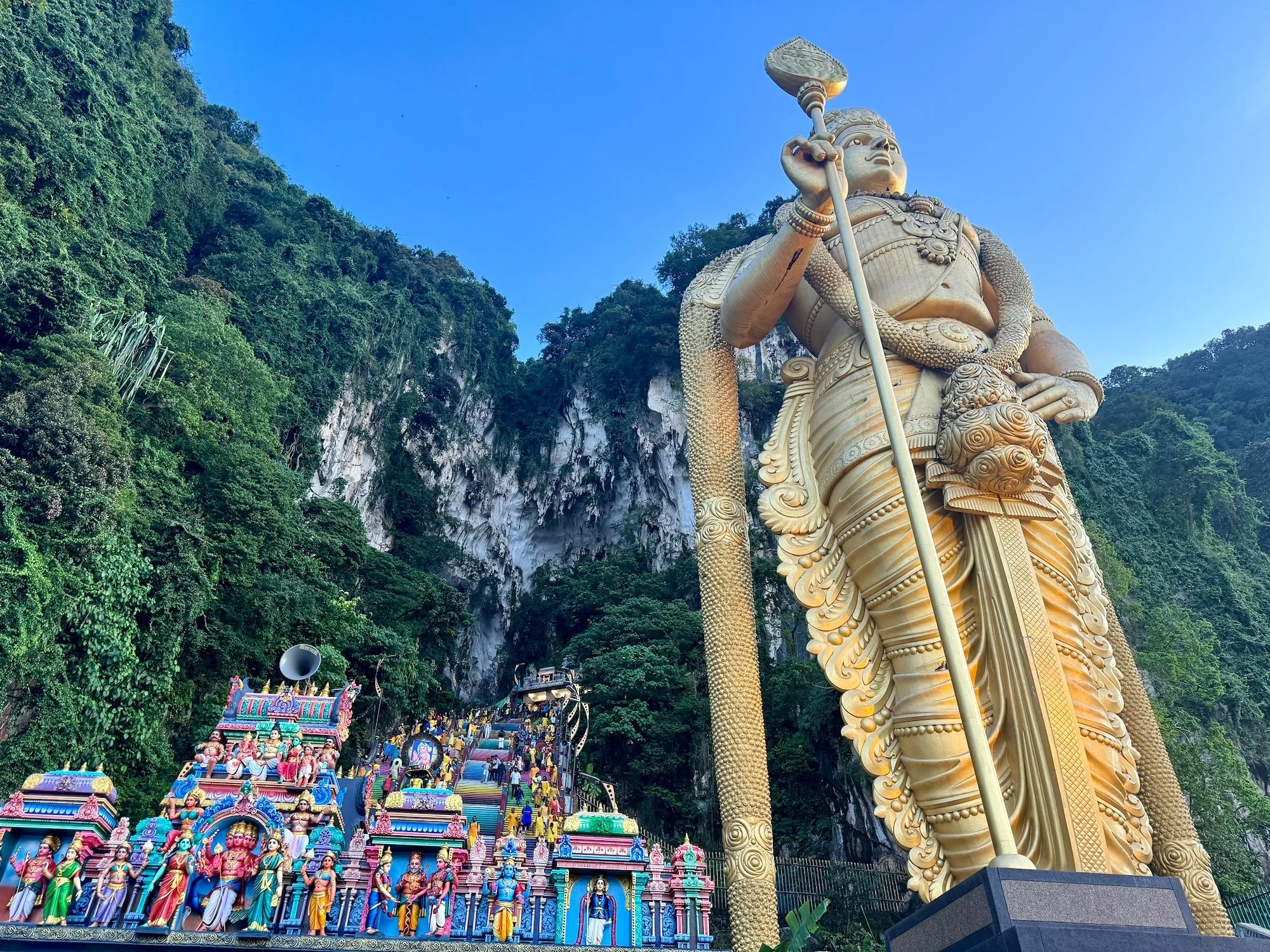
Although we only had about fifteen kilometres to cover, it took over sixteen hours, as we stopped repeatedly for prayers and chanting along the way. The cave complex finally shimmered into view through the afternoon heat. But one last challenge still loomed ahead: a climb up some 270 steps to a temple hidden in the side of a mountain. There, priests waited to relieve the pilgrims of their kavadi, as the spiky burdens are known, before treating their wounds with sacred ash.

At a tea stall at the bottom of the steps, I watched as a dapper middle-aged man in flowing white robes and matching bushy whiskers descended from the temple, his mission complete. Judging by his jaunty gait and friendly smile as he approached to order a brew, I reckoned he might put up with a couple of questions from an ignorant outsider, so I sidled up and introduced myself.
I was surprised to learn that my new acquaintance, Narendra, was a chemical engineer from Kuala Lumpur rather than the full-time mystic I had presumed, and that most of the other pilgrims were similarly holding down day jobs. I then asked him the question that had been bugging me since last night – why on earth were they all inflicting such suffering on themselves in the name of a festival that was supposed to celebrate the triumph of good over evil and so, surely, of pleasure over pain?
Narendra gave me a knowing smile and then motioned for us to sit down on the low wooden stools next to the counter. As we sipped our sweet, milky chai, he told me I needed to remember that Lord Murugan’s epic victory had been won only after a very tough battle. This served, he said, as a telling reminder that the lasting good things in life do not come easy, instead requiring short-term pain to unlock long-term gain. Despite already knowing this with the rational parts of our brains, our illogical human emotions all too often balk at that initial grind required. At the same time, we instead get seduced by fleeting pleasures that offer exactly the opposite deal – a brief immediate gain in return for enduring future pain. The result is that we end up sacrificing sustainable happiness for a transient thrill.

He paused, took another sip of chai, and then motioned to a neighbouring stall selling thickly battered bhajis. This, he explained, offered the perfect example – even though we know that fast food is bad for us, the anticipation of the mere couple of seconds of pleasure that biting into that oily crispiness will bring all too easily persuades us to override this knowledge.
Narendra told me that, to correct such a deeply ingrained bias for immediate gratification regardless of the subsequent cost, the human brain requires a truly visceral lesson. And this is where the piercings and pain of Thaipusam come in. By enduring them, the pilgrims learn to overcome their immediate urges and so build mental strength. They prove to themselves that they do not have to be slaves to every desire that comes into their heads. If they can resist the urge to shed their kavadi for a night, then resisting everyday temptations becomes child’s play. By putting on physical chains, they learn to break free of mental ones.

I smiled as his words hit home and I realised that, however unfathomable the rituals had at first seemed to me, they in fact echoed a Latin axiom that humans have quoted for centuries: per aspera ad astra – through hardship to the stars. I was now almost tempted to give the piercings a go myself but, as Narendra had also advised a step-by-step approach, I instead settled for cancelling my planned order of a bhaji to go.